Finance summary
ملخص كتاب نزهة عشوائية في وول ستريت: أهم الأفكار والدروس
اقرأ ملخص كتاب نزهة عشوائية في وول ستريت مع أهم الأفكار والدروس العملية والنقاط الرئيسية في دقائق.
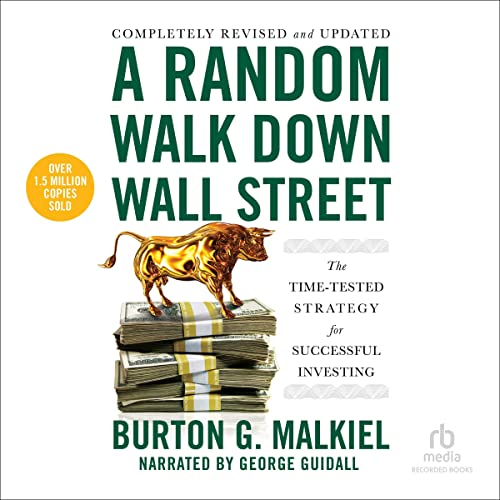
Author: Burton G. Malkiel
Category: Finance
Published: 2000
Pages: 704
أهم الأفكار
- **The Random Walk Theory**: Stock prices follow a random walk—future price movements are independent of past movements, making short-term prediction impossible.
- **Efficient Market Hypothesis (EMH)**: Markets efficiently incorporate all available information into stock prices, rendering technical and fundamental analysis ineffective for consistent outperformance.
- **Technical Analysis is Futile**: The Weak Form EMH proves that past price patterns cannot predict future prices. Charting is statistically meaningless after transaction costs.
- **Fundamental Analysis Cannot Beat the Market**: The Semi-Strong Form EMH shows that by the time you act on public information, the market has already priced it in.
- **The Indexing Imperative**: Since beating the market is nearly impossible, the optimal strategy is to match the market through ultra-low-cost broad-market index funds.
- **Fees are the Enemy**: High management fees and transaction costs are guaranteed drags on performance. A 1.5% annual fee can destroy over 50% of your wealth over 40 years.
عن هذا الملخص
📚 The Epistemology of Prudence: A Deconstruction of Malkiel's "A Random Walk Down Wall Street" 1. Executive Summary and Foundational Framework Burton G. Malkiel's "A Random Walk Down Wall Street: The Time Tested Strategy for Successful Investing" stands as a foundational text in modern financial literature, offering a profoundly counterintuitive yet empirically grounded thesis: that the short term, daily price movements of stocks are fundamentally unpredictable—a random walk. Concise Introduction 📝 Malkiel's central, challenging thesis is that the price of a stock at any given moment is an unbiased reflection of all available information, rendering future short term movements essentially...